


गणितीय नियताङ्क
गणितीय नियताङ्क (mathematical constant) ऊ सङ्ख्या (प्रायः वास्तविक सङ्ख्या) हे जे गणितमे स्वभावतः उत्पन्न होवहे । उदाहरण - पाइ (π), आयलर सङ्ख्या, इ (e) आदि ।
नियताङ्क एवं श्रेणी
[सम्पादित करथिन | स्रोत सम्पादित करथिन]—तालिका संरचना--
- मान : नियताङ्कके सङ्ख्यात्मक मान
- लैटेक्स (LaTeX): TeX प्रारूपमे सूत्र या श्रेणी
- सूत्र: मैथमैटिका (Mathematica) या वुल्फ्रैम अल्फा (Wolfram Alpha) आदिमे प्रयोग लागि
- OEIS: On-Line Encyclopedia of Integer Sequences
- सतत भिन्न: सरल प्रारूप [to integer; frac1, frac2, frac3, ...] मे । (यदि आवर्ती होवे त कोष्टकमे)
- Nº:
- - पूर्ण सङ्ख्या
- - परिमेय सङ्ख्या
- - अपरिमेय सङ्ख्या
- - प्रागनुभविक सङ्ख्या (Transcendental number)
- - समिश्र सङ्ख्या (complex number)
- -क्वाटरनीयोञ्ज (Quarternions)
- - ऑक्टोनॉट्स/ऑक्टोनीयन


(octonion)
- - sedenions

ई सूचीके 'मान', 'नाम', 'OEIS' आदि पर क्लिक करके ई सूचीके आवश्यकतानुसार क्रमित (ordered) कर सकही ।
| मान | नाम | सङ्केत | लैटेक्स | सूत्र | Nº | OEIS | सतत भिन्न |
|---|---|---|---|---|---|---|---|
| 3.62560990822190831193068515586767200 | गामा (1/4)[१] | Γ(1/4)! | T | A068466 | [3;1,1,1,2,25,4,9,1,1,8,4,1,6,1,1,19,1,1,4,1,...] | ||
| 0.95531661812450927816385710251575775 | जादुई कोण (Magic angle)[२] | arctan(sqrt(2)) | I | A195696 | [0;1,21,2,1,1,1,2,1,2,2,4,1,2,9,1,2,1,1,1,3,...] | ||
| 1.44466786100976613365833910859643022 | Steiner number, Iterated Exponential Constant[३] | = Upper Limit of Tetration | e^(1/e) | T | A073229 | [1;2,4,55,27,1,1,16,9,3,2,8,3,2,1,1,4,1,9,...] | |
| 0.69220062755534635386542199718278976 | Minimum value of función ƒ(x) = xx[४] |
= Inverse Steiner Number | e^(-1/e) | T | A072364 | [0;1,2,4,55,27,1,1,16,9,3,2,8,3,2,1,1,4,1,9,...] | |
| 0.34053732955099914282627318443290289 | Pólya Random Walk constant[५] |
|
1-16*Sqrt[2/3]*Pi^3 /((Gamma[1/24] *Gamma[5/24] *Gamma[7/24] *Gamma[11/24]) |
T | A086230 | [0;2,1,14,1,3,8,1,5,2,7,1,12,1,5,59,1,1,1,3,...] | |
| 0.54325896534297670695272829530061323 | Bloch-Landau constant[६] | gamma(1/3) *gamma(5/6) /gamma(1/6) |
T | A081760 | [0;1,1,5,3,1,1,2,1,1,6,3,1,8,11,2,1,1,27,4,...] | ||
| 0.18785964246206712024851793405427323 | MRB Constant, Marvin Ray Burns[७][८][९] | Sum[n=1 to ∞] {(-1)^n (n^(1/n)-1)} |
T | A037077 | [0;5,3,10,1,1,4,1,1,1,1,9,1,1,12,2,17,2,2,1,...] | ||
| 0.74759792025341143517873094383017817 | Rényi's Parking Constant[१०] | [e^(-2*Gamma)] * Int{n,0,∞}[ e^(- 2 *Gamma(0,n)) /n^2] |
T | A050996 | [0;1,2,1,25,3,1,2,1,1,12,1,2,1,1,3,1,2,1,43,...] | ||
| 1.27323954473516268615107010698011489 | रामानुजन-फोर्सिथ श्रेणी[११] | Sum[n=0 to ∞] {[(2n-3)!! /(2n)!!]^2} |
T | A088538 | [1;3,1,1,1,15,2,72,1,9,1,17,1,2,1,5,1,1,10,...] | ||
| 1.46707807943397547289779848470722995 | Porter Constant[१२] |
|
6*ln2/Pi^2(3*ln2+ 4 EulerGamma- WeierstrassZeta'(2) *24/Pi^2-2)-1/2 | T | A086237 | [1;2,7,10,1,2,38,5,4,1,4,12,5,1,5,1,2,3,1,...] | |
| 4.66920160910299067185320382046620161 | Feigenbaum constant δ[१३] |
|
T | A006890 | [4;1,2,43,2,163,2,3,1,1,2,5,1,2,3,80,2,5,...] | ||
| 2.50290787509589282228390287321821578 | Feigenbaum constant α[१४] | T | A006891 | [2;1,1,85,2,8,1,10,16,3,8,9,2,1,40,1,2,3,...] | |||
| 0.62432998854355087099293638310083724 | Golomb–Dickman constant[१५] | N[Int{n,0,1}[e^Li(n)],34] | T | A084945 | [0;1,1,1,1,1,22,1,2,3,1,1,11,1,1,2,22,2,6,1,...] | ||
| 23.1406926327792690057290863679485474 | Gelfond constant[१६] | Sum[n=0 to ∞] {(pi^n)/n!} |
T | A039661 | [23;7,9,3,1,1,591,2,9,1,2,34,1,16,1,30,1,...] | ||
| 7.38905609893065022723042746057500781 | शंकु नियतांक (Conic constant), Schwarzschild constant[१७] | Sum[n=0 to ∞] {2^n/n!} |
T | A072334 | [7;2,1,1,3,18,5,1,1,6,30,8,1,1,9,42,11,1,...] = [7,2, (1,1,n,4*n+6,n+2)], n = 3, 6, 9, etc. | ||
| 0.35323637185499598454351655043268201 | Hafner-Sarnak-McCurley constant (1)[१८] | prod[k=1 to ∞] {1-(1-prod[j=1 to n] {1-ithprime(k)^-j})^2} | T | A085849 | [0;2,1,4,1,10,1,8,1,4,1,2,1,2,1,2,6,1,1,1,3,...] | ||
| 0.60792710185402662866327677925836583 | Hafner-Sarnak-McCurley constant (2)[१९] | Prod{n=1 to ∞} (1-1/ithprime (n)^2) |
T | A059956 | [0;1,1,1,1,4,2,4,7,1,4,2,3,4,10,1,2,1,1,1,...] | ||
| 1.58496250072115618145373894394781651 | Hausdorff dimension, Sierpinski triangle[२०] | (Sum[n=0 to ∞] {1/ (2^(2n+1) (2n+1))})/ (Sum[n=0 to ∞] {1/ (3^(2n+1) (2n+1))}) |
T | A020857 | [1;1,1,2,2,3,1,5,2,23,2,2,1,1,55,1,4,3,1,1,...] | ||
| 0.12345678910111213141516171819202123 | Champernowne constant[२१] | T | A033307 | [0;8,9,1,149083,1,1,1,4,1,1,1,3,4,1,1,1,15,...] | |||
| 0.76422365358922066299069873125009232 | Landau-Ramanujan constant[२२] | T | A064533 | [0;1,3,4,6,1,15,1,2,2,3,1,23,3,1,1,3,1,1,6,4,...] | |||
| 0.11000100000000000000000100... | Liouville number[२३] | Sum[n=1 to ∞] {10^(-n!)} |
T | A012245 | [1;9,1,999,10,9999999999999,1,9,999,1,9] | ||
| १.९२८७८००... | राइट नियताङ्क (Wright constant)[२४] | A086238 | [1; 1, 13, 24, 2, 1, 1, 3, 1, 1, 3] | ||||
| 2.71828182845904523536028747135266250 | Number e, Euler's number[२५] | Sum[n=0 to ∞] {1/n!} |
T | A001113 | [2;1,2,1,1,4,1,1,6,1,1,8,1,1,10,1,1,12,1,...] = [2;(1,2p,1)], p∈ℕ | ||
| 0.36787944117144232159552377016146086 | Reverse of Number e[२६] | Sum[n=2 to ∞] {(-1)^n/n!} |
T | A068985 | [0;2,1,1,2,1,1,4,1,1,6,1,1,8,1,1,10,1,1,12,...] = [0;2,1, (1,2p,1)], p∈ℕ | ||
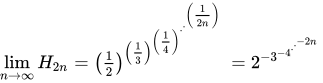
| 0.6903471261... | Upper iterated exponential[२७] | 2^-3^-4^-5^-6^ -7^-8^-9^-10^ -11^-12^-13 … |
T | [0;1,2,4,2,1,3,1,2,2,1,4,1,2,4,61,5,...] | |||
| 0.6583655992... | Lower límit iterated exponential[२८] | 2^-3^-4^-5^-6^ -7^-8^-9^-10^ -11^-12 … |
T | [0;1,1,1,12,1,2,1,1,4,3,1,1,2,1,2,1,51,2,2,1,...] | |||
| 0.63661977236758134307553505349005745 | २/π, François Viète product[२९] | T | A060294 | [0;1,1,1,3,31,1,145,1,4,2,8,1,6,1,2,3,1,4,...] | |||
| 3.14159265358979323846264338327950288 | π सङ्ख्या, Archimedes number[३०] | Sum[n=0 to ∞] {(-1)^n 4/(2n+1)} |
T | A000796 | [3;7,15,1,292,1,1,1,2,1,3,1,14,2,1,1,2,2,2,...] | ||
| 1.902160583104 | Brun 2 constant = Σ inverse of Twin primes[३१] | A065421 | [1; 1, 9, 4, 1, 1, 8, 3, 4, 4, 2, 2] | ||||
| 0.870588379975 | Brun 4 constant = Σ inv.prime quadruplets |
|
A213007 | [0; 1, 6, 1, 2, 1, 2, 956, 3, 1, 1] | |||
| 0.46364760900080611621425623146121440 | Machin-Gregory serie[३२] | Sum[n=0 to ∞] {(-1)^n (1/2)^(2n+1)/(2n+1)} |
T | A073000 | [0;2,6,2,1,1,1,6,1,2,1,1,2,10,1,2,1,2,1,1,1,...] | ||
| 0.59634736232319407434107849936927937 | Euler-Gompertz constant[३३] | integral[0 to ∞] {(e^-n)/(1+n)} |
T | A073003 | [0;1,1,2,10,1,1,4,2,2,13,2,4,1,32,4,8,1,1,1,...] | ||
| 0.69777465796400798200679059255175260 | Continued fraction constant, Bessel function | (Sum [n=0 to ∞] {n/(n!n!)}) / (Sum [n=0 to ∞] {1/(n!n!)}) |
A052119 | [0;1,2,3,4,5,6,7,8,9,10,11,12,13,14,15,16,...] = [0;(p+1)], p∈ℕ | |||
| 0.43828293672703211162697516355126482 + 0.36059247187138548595294052690600 i |
अनंत टिट्रेशन/Tetration i का |
(2/Pi) i ProductLog[-((Pi/2) i)] | A077589 A077590 |
[0;2,3,1,1,4,2,2,1,10,2,1,3,1,8,2,1,2,1, ...] + [0;2,1,3,2,2,3,1,5,5,1,2,1,10,10,6,1,1...] i | |||
| 2.74723827493230433305746518613420282 | Ramanujan nested radical[३४] | (2+sqrt(5) +sqrt(15 -6 sqrt(5)))/2 |
I | [2;1,2,1,21,1,7,2,1,1,2,1,2,1,17,4,4,1,1,4,2,...] | |||
| 1.01494160640965362502120255427452028 | Gieseking constant | . |
sqrt(3)*3/4 *(1 -Sum[n=0 to ∞] {1/((3n+2)^2)} +Sum[n=1 to ∞] {1/((3n+1)^2)}) |
T | A143298 | [1;66,1,12,1,2,1,4,2,1,3,3,1,4,1,56,2,2,11,...] | |
| 1.66168794963359412129581892274995074 | Somos' quadratic recurrence constant | prod[n=1 to ∞] {n ^(1/2)^n} |
T | A065481 | [1;1,1,1,21,1,1,1,6,4,2,1,1,2,1,3,1,13,13,...] | ||
| 0.56714329040978387299996866221035555 | Omega constant, Lambert W function | Sum[n=1 to ∞] {(-n)^(n-1)/n!} |
A030178 | [0;1,1,3,4,2,10,4,1,1,1,1,2,7,306,1,5,1,2,1,...] | |||
| 0.96894614625936938048363484584691860 | Beta(3)[३५] | Sum[n=1 to ∞] {(-1)^(n+1) /(-1+2n)^3} |
T | A153071 | [0;1,31,4,1,18,21,1,1,2,1,2,1,3,6,3,28,1,...] | ||
| 2.23606797749978969640917366873127624 | Square root of 5, Gauss sum[३६] | Sum[k=0 to 4] {e^(2k^2 pi i/5)} |
I | A002163 | [2;4,4,4,4,4,4,4,4,4,4,4,4,4,4,4,4,4,4,4,4,...] = [2;(4),...] | ||
| 3.35988566624317755317201130291892717 | Prévost constant |
Fn: Fibonacci series |
Sum[n=1 to ∞] {1/Fibonacci[n]} |
I | A079586 | [3;2,1,3,1,1,13,2,3,3,2,1,1,6,3,2,4,362,...] | |
| 2.68545200106530644530971483548179569 | Khinchin's constant[३७] | Prod[n=1 to ∞] {(1+1/(n(n+2))) ^(ln(n)/ln(2))} |
? | A002210 | [2;1,2,5,1,1,2,1,1,3,10,2,1,3,2,24,1,3,2,...] | ||










सन्दर्भ
[सम्पादित करथिन | स्रोत सम्पादित करथिन]- ↑ Refaat El Attar (2006). Special Functions And Orthogonal Polynomials. Lulu Press. p. 58. ISBN 1-4116-6690-9.
- ↑ Andras Bezdek (2003). Discrete Geometry. Marcel Dekkcr, Inc. p. 150. ISBN 0-8247-0968-3.
- ↑ Eli Maor (2006). e: The Story of a Number. Princeton University Press. ISBN 0-691-03390-0. Archived from the original on 29 जून 2014. Retrieved 3 सतम्बर 2013.
{{cite book}}: Check date values in:|access-date=(help) - ↑ Clifford A. Pickover (2005). A Passion for Mathematics. John Wiley & Sons, Inc. p. 90. ISBN 0-471-69098-8. Archived from the original on 11 दिसम्बर 2013. Retrieved 3 सितम्बर 2013.
- ↑ Steven R. Finch (2003). Mathematical Constants. Cambridge University Press. p. 322. ISBN 3-540-67695-3.
- ↑ Eric W. Weisstein (2003). CRC Concise Encyclopedia of Mathematics, Second Edition. CRC Press. p. 1688. ISBN 1-58488-347-2.
- ↑ M.R.Burns (1999). Root constant. http://marvinrayburns.com/. Archived from the original on 20 फरवरी 2017. Retrieved 3 सितम्बर 2013.
{{cite book}}: External link in|publisher= - ↑ Richard E. Crandall (2012). Uni ed algorithms for polylogarithm, L-series, and zeta variants (PDF). http://www.perfscipress.com. Archived from the original (PDF) on 30 अप्रैल 2013. Retrieved 3 सितम्बर 2013.
{{cite book}}: External link in|publisher=|title=at position 5 (help) - ↑ RICHARD J. MATHAR (2010). NUMERICAL EVALUATION OF THE OSCILLATORY INTEGRAL OVER exp(I pi x)x^1/x BETWEEN 1 AND INFINITY (PDF). http://arxiv.org/abs/0912.3844. Archived (PDF) from the original on 15 दिसम्बर 2018. Retrieved 3 सितम्बर 2013.
{{cite book}}: External link in|publisher=|title=at position 40 (help) - ↑ Weisstein, Eric W. Rényi's Parking Constants. MathWorld. p. (4). Archived from the original on 13 दिसम्बर 2013. Retrieved 3 सितम्बर 2013.
- ↑ H. K. Kuiken (2001). Practical Asymptotics. KLUWER ACADEMIC PUBLISHERS. p. 162. ISBN 0-7923-6920-3.
- ↑ Michel A. Théra (2002). Constructive, Experimental, and Nonlinear Analysis. CMS-AMS. p. 77. ISBN 0-8218-2167-9.
- ↑ Kathleen T. Alligood (1996). Chaos: An Introduction to Dynamical Systems. Springer. ISBN 0-387-94677-2. Archived from the original on 7 जुलाई 2014. Retrieved 3 सितंबर 2013.
{{cite book}}: Check date values in:|access-date=(help) - ↑ K. T. Chau,Zheng Wang (201). Chaos in Electric Drive Systems: Analysis, Control and Application. John Wiley & Son. p. 7. ISBN 978-0-470-82633-1. Archived from the original on 7 जुलाई 2014. Retrieved 3 सितम्बर 2013.
{{cite book}}: ISBN / Date incompatibility (help) - ↑ Eric W. Weisstein (2002). CRC Concise Encyclopedia of Mathematics. Crc Press. p. 1212.
- ↑ David Wells (1997). The Penguin Dictionary of Curious and Interesting Numbers. Penguin Books Ltd. p. 4.
- ↑ Jvrg Arndt,Christoph Haenel. Pi: Algorithmen, Computer, Arithmetik. Springer. p. 67. ISBN 3-540-66258-8.
- ↑ Steven R. Finch (2003). Mathematical Constants. p. 110. ISBN 3-540-67695-3.
- ↑ Holger Hermanns,Roberto Segala (2000). Process Algebra and Probabilistic Methods. Springer-Verlag. p. 270. ISBN 3-540-67695-3.
- ↑ Eric W. Weisstein (2002). CRC Concise Encyclopedia of Mathematics, Second Edition. CRC Press. p. 1356. ISBN 1-58488-347-2. Archived from the original on 3 जनवरी 2014. Retrieved 3 सितम्बर 2013.
- ↑ Michael J. Dinneen,Bakhadyr Khoussainov,Prof. Andre Nies (2012). Computation, Physics and Beyond. Springer. p. 110. ISBN 978-3-642-27653-8. Archived from the original on 4 अप्रैल 2016. Retrieved 3 सितम्बर 2013.
{{cite book}}: CS1 maint: multiple names: authors list (link) - ↑ Richard E. Crandall,Carl B. Pomerance (2005). Prime Numbers: A Computational Perspective. Springer. p. 80. ISBN 978-0387-25282-7. Archived from the original on 19 जुलाई 2014. Retrieved 3 सितम्बर 2013.
- ↑ Calvin C. Clawson (2003). Mathematical Traveler: Exploring the Grand History of Numbers. Perseus. p. 187. ISBN 0-7382-0835-3. Archived from the original on 9 सितम्बर 2016. Retrieved 3 सितम्बर 2013.
- ↑ Paulo Ribenboim (2000). My Numbers, My Friends: Popular Lectures on Number Theory. Springer-Verlag. p. 66. ISBN 0-387-98911-0.
- ↑ E.Kasner y J.Newman. (2007). Mathematics and the Imagination. Conaculta. pp. p.77. ISBN 978-968-5374-20-0.
{{cite book}}:|pages=has extra text (help) - ↑ Eli Maor (1994). "e": The Story of a Number. Princeton University Press. p. 37. ISBN 978-0-691-14134-3. Archived from the original on 10 सितम्बर 2016. Retrieved 3 सितम्बर 2013.
- ↑ Theo Kempermann (2005). Zahlentheoretische Kostproben. Freiburger graphische betriebe. p. 139. ISBN 3-8171-1780-9.[मृत कड़ी]
- ↑ Steven Finch (2003). [? http://books.google.com/books?id=DL5iVYNoEa0C&pg=PA449&lpg=PA449&dq=0.6583655992&source=bl&ots=N6P2m6uQBr&sig=iXVbk64hcgZ7n8wxM8lMcZx3tOE&hl=es&sa=X&ei=YoFpUZ_6Ds-d7gaywYHwAw&redir_esc=y#v=onepage&q=0.6583655992&f=false Mathematical Constants]. Cambridge University Press. p. 449. ISBN 0-521-81805-2. Archived from the original on 11 नवम्बर 2012. Retrieved 3 सितम्बर 2013.
{{cite book}}: Check|url=value (help) - ↑ Jorg Arndt,Christoph Haenel (2000). Pi -- Unleashed. Verlag Berlin Heidelberg. p. 13. ISBN 3-540-66572-2. Archived from the original on 10 सितम्बर 2016. Retrieved 3 सितम्बर 2013.
- ↑ Michael Trott (2004). The Mathematica GuideBook for Programming. Springer Science. p. 173. ISBN 0-387-94282-3. Archived from the original on 4 जुलाई 2014. Retrieved 3 सितम्बर 2013.
- ↑ Thomas Koshy (2007). Elementary Number Theory with Applications. Elsevier. p. 119. ISBN 978-0-12-372-487-8. Archived from the original on 7 जुलाई 2014. Retrieved 3 सितम्बर 2013.
- ↑ John Horton Conway, Richard K. Guy. (1995). The Book of Numbers. Copernicus. p. 242. ISBN 0-387-97993-X. Archived from the original on 12 जनवरी 2014. Retrieved 3 सितम्बर 2013.
- ↑ Annie Cuyt, Viadis Brevik Petersen, Brigitte Verdonk, William B. Jones (2008). Handbook of continued fractions for special functions. Springer Science. p. 190. ISBN 978-1-4020-6948-2. Archived from the original on 8 मार्च 2016. Retrieved 3 सितम्बर 2013.
{{cite book}}: CS1 maint: multiple names: authors list (link) - ↑ Bruce C. Berndt,Robert Alexander Rankin (2001). Ramanujan: essays and surveys. American Mathematical Society, London Mathematical Society. p. 219. ISBN 0-8218-2624-7.
- ↑ Michael A. Idowu (2012). Fundamental relations between the Dirichlet beta function, euler numbers, and Riemann zeta function for positive integers. arXiv:1210.5559. p. 1. Archived from the original on 26 जनवरी 2019. Retrieved 3 सितम्बर 2013.
- ↑ P A J Lewis (2008). Essential Mathematics 9. Ratna Sagar. p. 24. ISBN 9788183323673.
- ↑ Julian Havil (2003). Gamma: Exploring Euler's Constant. Princeton University Press. p. 161. ISBN 9780691141336. Archived from the original on 26 जून 2014. Retrieved 3 सितम्बर 2013.
बाहरी कड़ी
[सम्पादित करथिन | स्रोत सम्पादित करथिन]- Constants - from Wolfram MathWorld
- Inverse symbolic calculator (CECM, ISC) (tells you how a given number can be constructed from mathematical constants)
- On-Line Encyclopedia of Integer Sequences (OEIS)
- Simon Plouffe's inverter
- Steven Finch's page of mathematical constants
- Xavier Gourdon and Pascal Sebah's page of numbers, mathematical constants and algorithms
श्रेणीसभ:
- CS1 errors: dates
- CS1 errors: external links
- CS1 errors: invisible characters
- CS1 errors: ISBN date
- CS1 maint: multiple names: authors list
- CS1 errors: extra text: pages
- सुधार योग्य सब लेख
- लेख जेकरामे सितम्बर 2021 से मृत कड़ी हे
- साँचामे अमान्य तिथि प्राचलवाला लेख
- मृत कड़ीवाला लेख
- CS1 errors: URL
- गणितीय नियताङ्क
- गणित